
/
© 2026 created by Identitors & Creative business
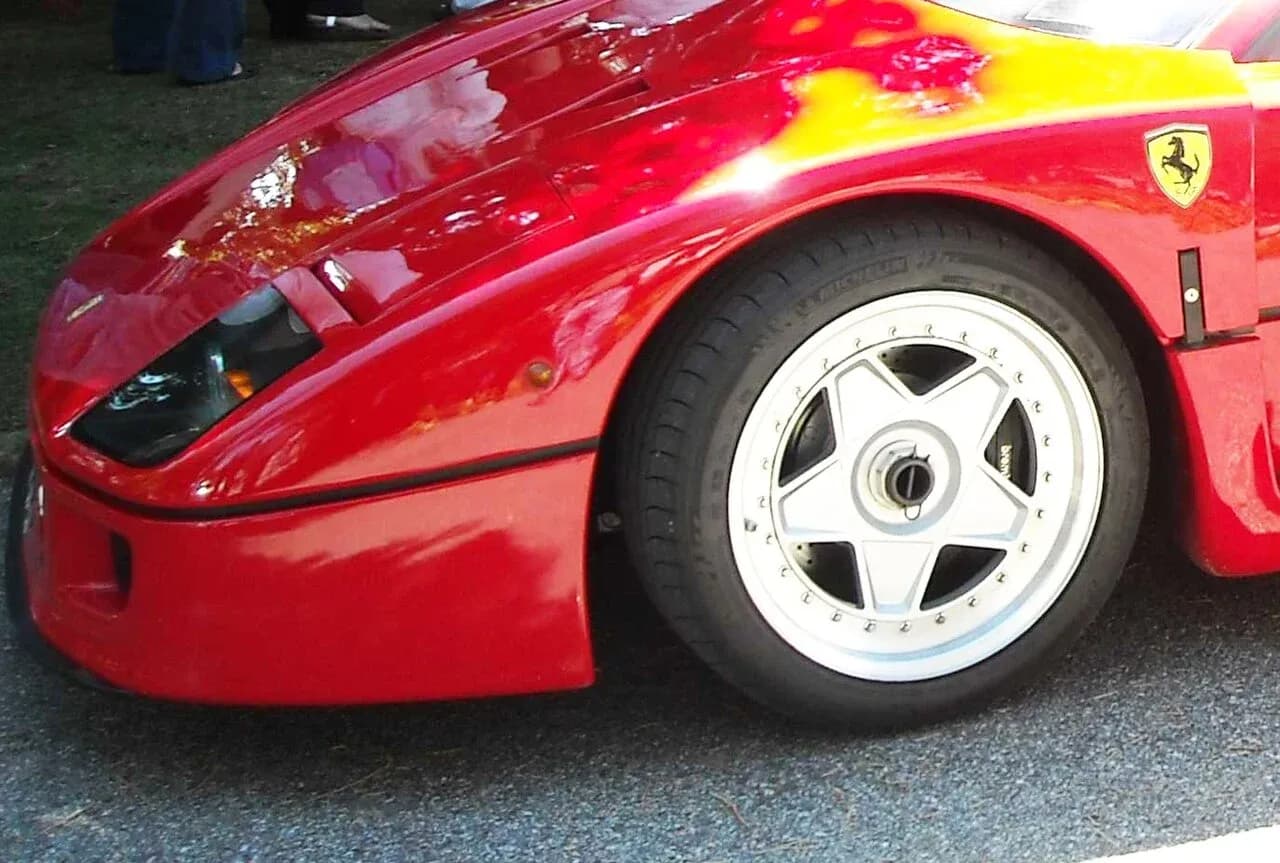
For the first time on a road car, Ferrari adopted a composite body made of carbon fibre, Kevlar, and aluminium bonded to a steel tubular frame. Dry weight: 1,100 kg.
The chassis of the Ferrari F40 represents one of the most significant structural innovations of the 1980s in the world of road-going supercars. For the first time on a production car, Maranello adopted a composite solution derived directly from Formula 1 experience and the 288 GTO Evoluzione project.
The basic structure is a tubular frame made of TIG-welded carbon steel tubes, conceptually similar to that of earlier grand tourers, but reinforced with Connolly bars and enlarged-section nodes. Bonded to this frame — not bolted — are the composite panels that form the body: a patented combination of Kevlar for tensile strength, carbon fibre for rigidity, and aluminium honeycomb for impact absorption. The adhesive used, developed in collaboration with the French company Ciba-Geigy, guarantees structural bonding verified in FIA tests.
The result was impressive for the time: torsional rigidity 20% higher than the 288 GTO, a declared dry weight of 1,100 kg — 1,250 kg in running order for US-spec cars with catalytic converters — and frontal impact energy absorption comparable to that of a sports prototype.
The outer body panels are also visible from inside the engine bay, where the Kevlar weave is left exposed as a clear statement of the “less is more” philosophy. The doors are also made of composite material, with aluminium hinges and integrated exterior handles to reduce aerodynamic drag.
From a maintenance perspective, this structure presents a major challenge for restoration. If damaged, the composite panels require certified repair procedures that very few workshops in the world are able to perform correctly. The Ferrari Classiche programme includes specific protocols for verifying the structural integrity of F40 chassis, with non-destructive testing (NDT) using ultrasound and thermography.
It is also because of this construction complexity that, more than 35 years later, a perfectly preserved F40 remains a rare object: the bodywork does not forgive impacts, poorly executed repairs show through the paint, and they drastically reduce the car’s market value.