
/
© 2026 created by Identitors & Creative business
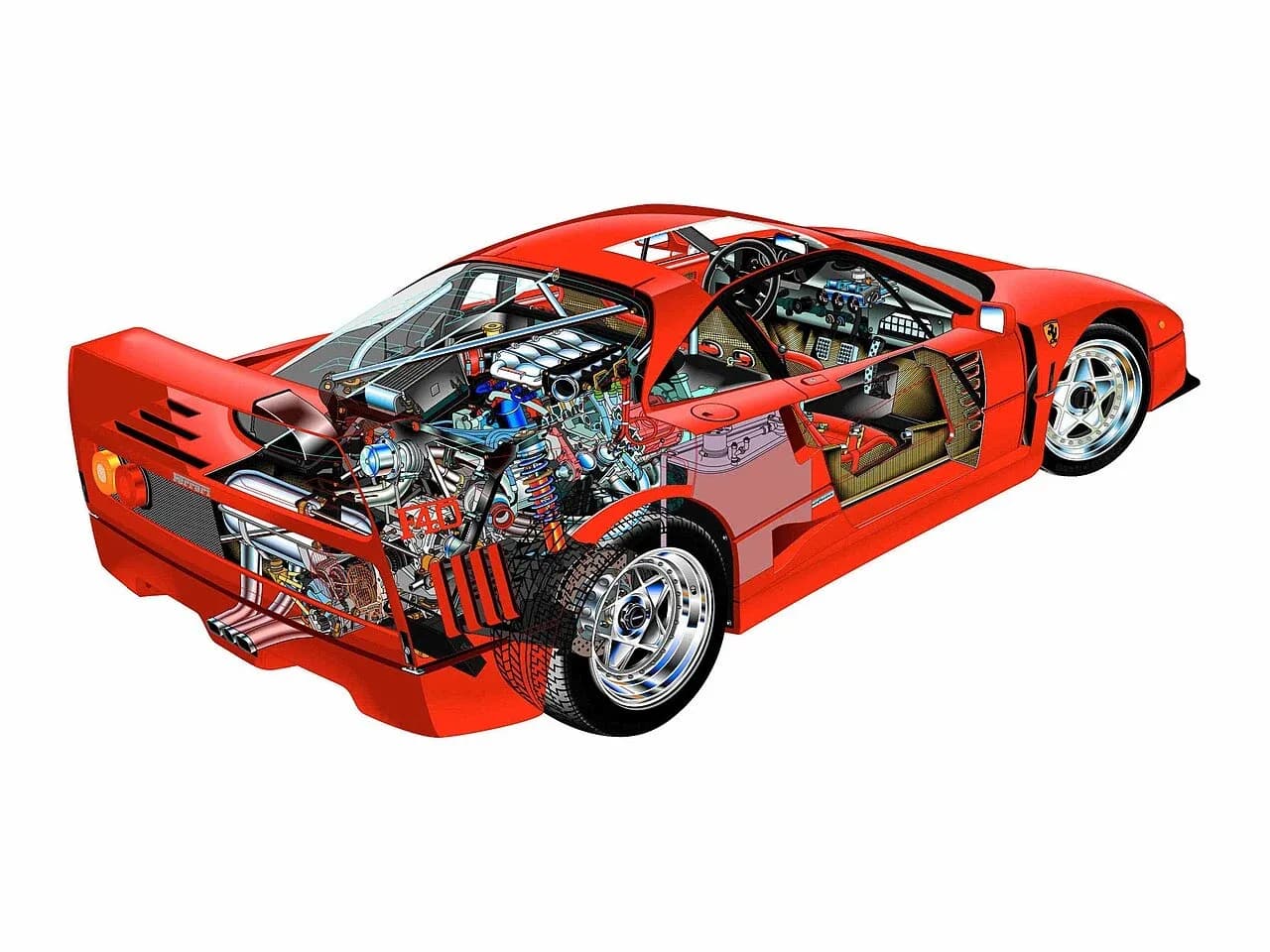
The 2,936 cc F120A engine produces 478 hp thanks to two IHI RHB5 turbochargers and a sophisticated Weber-Marelli IAW system. An engineering masterpiece born from the experience of the Lancia LC2.
The engine of the Ferrari F40, designated F120A, is one of the most closely studied V8s in supercar history. A 90-degree architecture, two banks of four cylinders, a light-alloy block, twin overhead camshafts per bank, and four valves per cylinder: “ordinary” numbers by Maranello standards, but deeply reworked compared with the 288 GTO engine from which it derives.
Its actual displacement is 2,936 cc, with an 82 mm bore and a 69.5 mm stroke. The true technical signature is the pair of IHI RHB5 turbochargers with Behr air-to-air intercoolers, capable of pushing boost pressure up to 1.1 bar. The compression ratio, kept at 7.7:1, was designed precisely to withstand the increased pressure without risk of detonation, working in combination with the new-generation Weber-Marelli IAW electronic management system.
Declared output is 478 hp at 7,000 rpm and 577 Nm of torque at 4,000 rpm, figures that allow 0–100 km/h in 4.1 seconds and a claimed top speed of 324 km/h, also certified by Road & Track at the time. The power delivery curve, partly due to the typical turbo lag of the era, features a sudden onset of boost at around 4,000 rpm: a behaviour that requires sensitivity on the throttle, but is an integral part of the car’s appeal.
Materazzi and his team borrowed many solutions from the Lancia LC2 Group C experience, particularly the geometry of the exhaust manifolds, wastegate management, and oil-temperature control through dedicated radiators positioned in the side sections. The titanium connecting rods — introduced on later-series cars — and forged Mahle pistons are further details that testify to the racing origins of the project.
From a maintenance perspective, the F120A engine requires a complete turbocharger overhaul every 30,000–40,000 km, replacement of the timing belts and belt tensioners every five years regardless of mileage, and periodic inspection of the flexible fuel lines, a known weak point on cars that are rarely used. Fuel pressure must be checked with a dedicated pressure gauge at 5.0 bar.
It is not a forgiving engine: it requires a specialised workshop, Ferrari-specific diagnostics such as SD2 or modern derivatives, and deep knowledge of the engine assembly. But it is precisely this complexity that makes it one of the few contemporary engines still capable, even today, of conveying the sensation of a “living” powerplant.