
/
© 2026 created by Identitors & Creative business
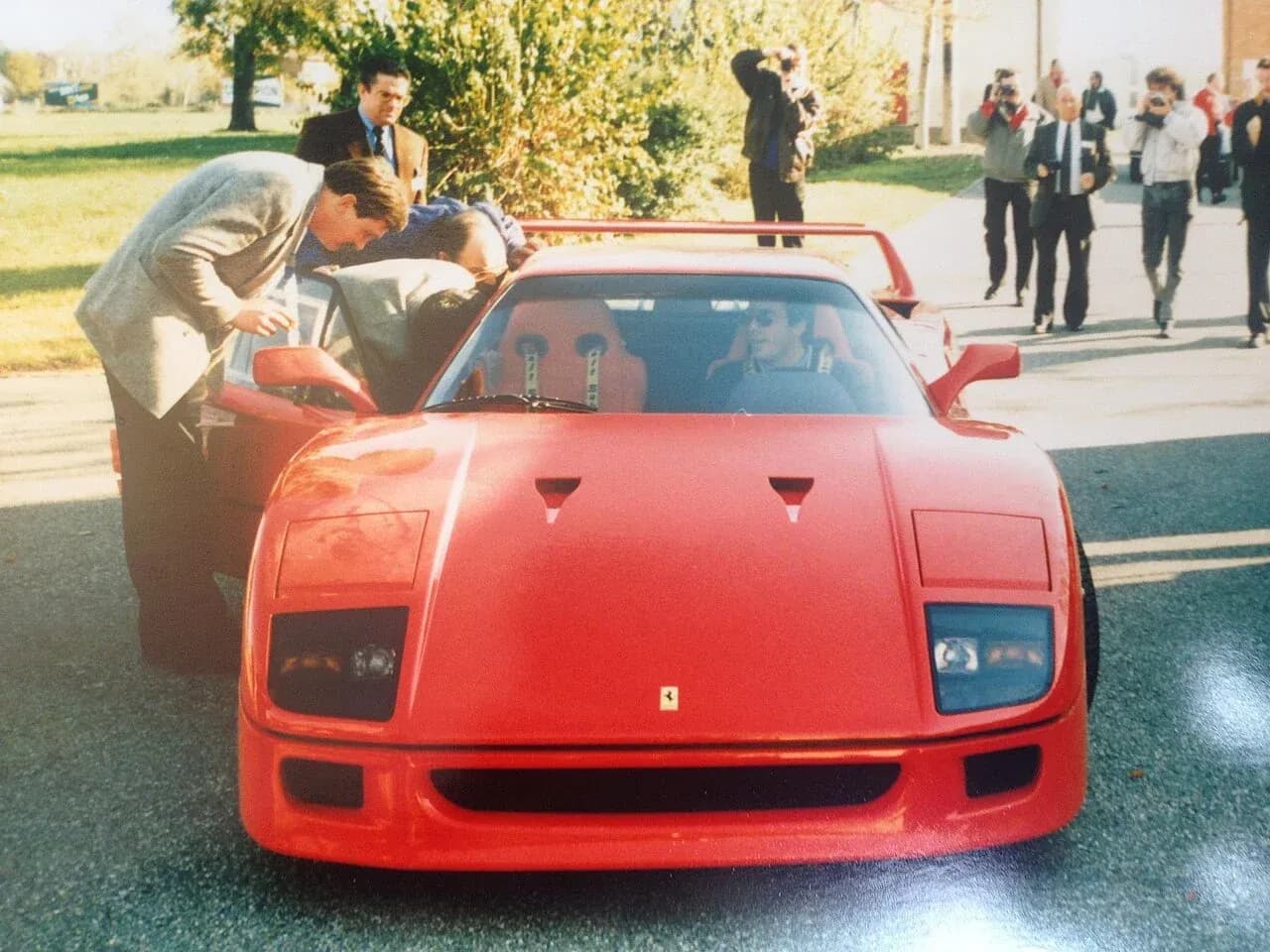
Born in just 13 months from Pininfarina’s pen and Nicola Materazzi’s engineering, the F40 is Enzo Ferrari’s mechanical testament to the 40th anniversary of the Maranello marque.
When, on 21 July 1987, Enzo Ferrari pulled the cover off the F40 in front of the international press gathered at the factory, he did so with a phrase that entered history: “I wanted to build the most beautiful, most powerful car, and we did it.” It was the gift the Drake gave to himself and to Ferrari’s 40th anniversary, but also — as would become clear shortly afterwards — the last model he would personally approve before his death in August 1988.
The F40 project was born from the ashes of the 288 GTO Evoluzione, a car developed for Group B before the World Rally Championship cancelled the category ahead of its debut. Nicola Materazzi, already the father of the 288 GTO and chief engineer of the F40, suggested to Enzo Ferrari that the know-how accumulated through those prototypes should not be wasted, but instead transformed into an extreme road car. Approval came in the summer of 1986: the programme was completed in just 13 months, a timeline that would be almost unthinkable today, even for an artisanal manufacturer.
The styling was entrusted to Pininfarina, under the direction of Leonardo Fioravanti and Aldo Brovarone. The brief was radical: zero aesthetic compromises, with aerodynamic flow taking priority above all else. Hence the enormous structural rear wing integrated into the tail, the NACA ducts carved into the flanks, the extraction vents above the wheel arches, and the wedge-shaped nose with pop-up headlights. No carpets, no traditional door panels, no conventional exterior handles: only fabric pull cords and sliding plexiglass windows instead of electric windows on the early cars.
The decision to keep the list price below half a billion lire — 390 million at launch — immediately turned the F40 into a speculative phenomenon. The 400 units initially planned eventually grew to 1,311 examples produced between 1987 and 1992, under pressure from demand: a decision criticised by purists but one that, more than three decades later, has helped keep alive an active community of owners around the world.
Materazzi recalled several times that, during visits to the prototypes, Enzo Ferrari would ask only one thing of the test drivers: “Let me hear the turbos.” That whistle of the two IHI units coming onto boost, clearly distinct from the roar of the V8, remains today the sonic signature that identifies an F40 at any gathering and sets it apart from any other Ferrari in history.
The F40 is therefore much more than a supercar: it is a manifesto of industrial philosophy, the final act of a manufacturer who still saw the automobile as a machine made to make the heart race before the numbers did.