
/
© 2026 created by Identitors & Creative business
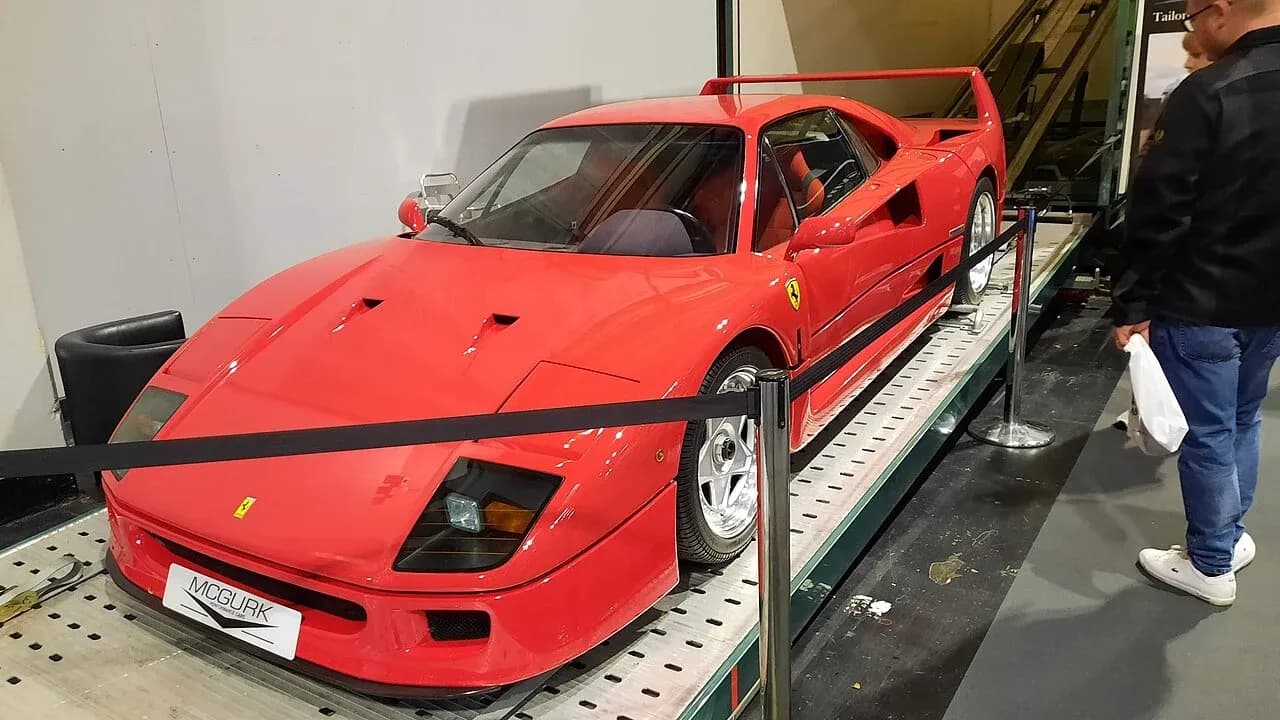
Three diametrically opposed philosophies: Ferrari’s analog purity, Porsche’s futuristic electronics, and McLaren’s uncompromising pursuit of perfection. Numbers and differences.
Comparing the Ferrari F40 with the Porsche 959 and the McLaren F1 means comparing three radically different approaches to the concept of a supercar. The three cars, produced between 1986 and 1998, share the role of “absolute queens” of their era, but express such distant engineering philosophies that the technical comparison is particularly instructive.
The Porsche 959 (1986–1989) is the most technologically advanced car of the trio. Electronically controlled variable all-wheel drive, hydraulically adjustable suspension with adaptive ride height, and a sequential twin-turbo 2.85L flat-six engine producing 450 hp: the 959 anticipated by more than ten years solutions that would later become standard in the premium sector. Its list price, 420,000 Deutsche Marks, was double that of a 911 Turbo of the time. The 292 units produced are today among the highest benchmarks of Porsche collecting.
The Ferrari F40 took the opposite approach: no electronics, rear-wheel drive, no ABS, minimal weight, and a twin-turbo engine with a six-speed manual gearbox. It is the most “old-school” of the three, but also the quickest in terms of power-to-weight ratio: 2.3 kg/hp versus the 959’s 2.9. Its top speed of 324 km/h is slightly higher than the 959’s 315 km/h, but the driving feel is completely different: the Ferrari demands experience, the Porsche forgives.
The McLaren F1 (1992–1998), arriving six years later, raised the bar even further. A naturally aspirated 6.1L BMW S70/2 V12 producing 627 hp, a full carbon-fibre monocoque — the first on a road car — a weight of 1,140 kg, a central driving position, and a top speed of 386 km/h confirmed at Volkswagen’s Ehra-Lessien Test Center in 1998 by Andy Wallace. The 106 units produced make it the rarest of the three: today, an F1 in excellent condition regularly exceeds $20 million at auction.
In terms of weight, the 959 is the heaviest at 1,450 kg due to its electronic systems and all-wheel-drive transmission; the F40 is the lightest among the twin-turbo cars, with a declared weight of 1,100 kg; the F1 sets the benchmark for a naturally aspirated V12 at 1,140 kg. For 0–200 km/h acceleration: the F40 takes 11.3 seconds, the 959 13.3 seconds, and the McLaren F1 9.4 seconds.
The comparison, still the subject of analysis in specialist magazines today, confirms that the three cars represent incompatible yet complementary philosophies: the 959 is the “Grand Tourer of the future,” the F40 is “mechanical purity,” and the F1 is “holistic perfection.” More than three decades later, all three remain unsurpassed for what they represented in their historical context.