
/
© 2026 created by Identitors & Creative business
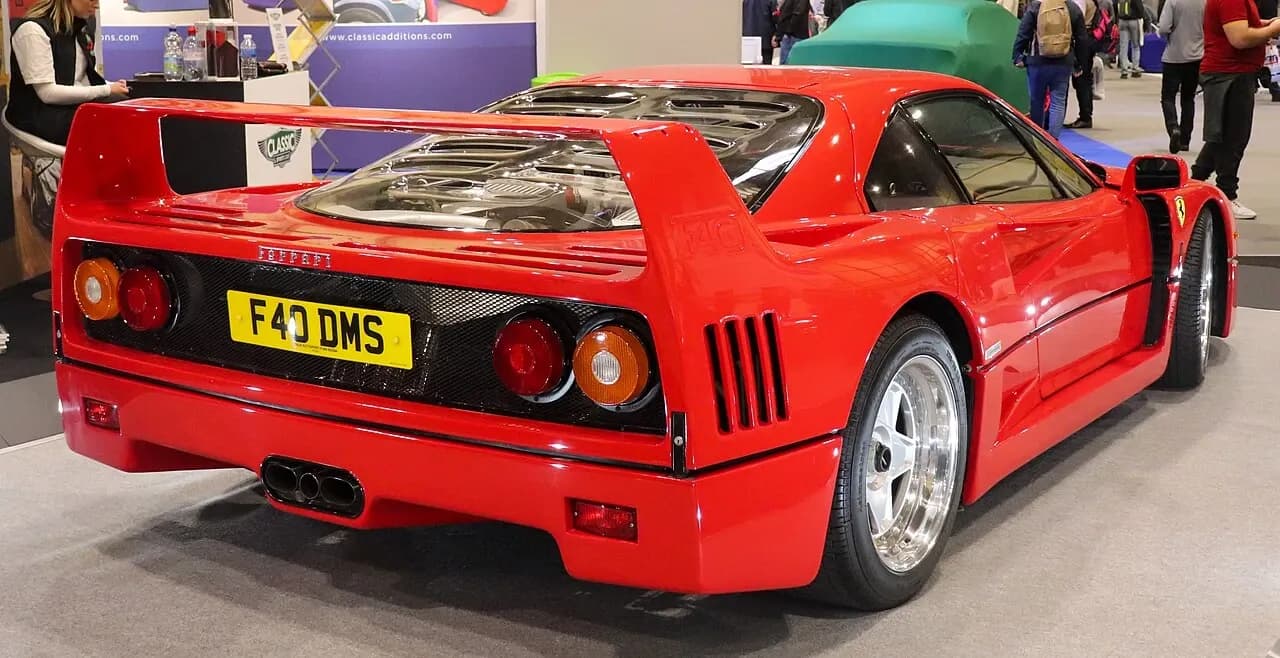
Pininfarina developed the bodywork in the Grugliasco wind tunnel, achieving 320 kg of aerodynamic downforce at 200 km/h thanks to a flat floor, diffuser, and structural wing.
The aerodynamics of the Ferrari F40 are one of the car’s least discussed yet most sophisticated aspects. Pininfarina, under the direction of Leonardo Fioravanti, carried out more than 300 hours of testing in the Grugliasco wind tunnel and later in Pininfarina’s Cambiano wind tunnel, starting from the aerodynamic base already developed on the 288 GTO Evoluzione.
The final drag coefficient is Cd 0.34, a value that is not exceptional in absolute terms but remarkable considering the downforce package: the F40 generates around 320 kg of aerodynamic load at 200 km/h, distributed 40% over the front axle and 60% over the rear. This balance, the result of a full flat floor, a three-channel rear diffuser, and the iconic structural rear wing, is what allows the car to remain stable at its top speed.
The rear wing is not an add-on element: it is an integral part of the body, fixed directly to the tubular structure and sized to generate downforce without excessively penalizing drag. Its angle of attack is fixed, designed for high-speed motorway use and for medium-fast circuits such as Fiorano.
The NACA ducts on the sides feed the side-mounted radiators for the engine oil and intercoolers. The vents above the rear wheel arches are not decorative: they extract hot airflow from the engine bay, preventing pressure build-up under the rear deck. The nose also plays a precise aerodynamic role: the lower fiberglass lip creates localized low pressure, contributing to front downforce.
Underneath, in addition to the diffuser, there are two lateral flow-management channels that direct air toward the rear brake area, aiding cooling and stability under braking. The ground effect, although not comparable to that of a sports prototype of the era, was clearly pursued and makes the F40 one of the first road cars with a truly racing-derived aerodynamic approach.
The later F40 LM and GTE versions adopted more aggressive splitters, an adjustable rear wing, and new diffusers, demonstrating how the base design was already prepared for performance evolutions without structural changes to the bodywork.